
{主关键词}
阴阳路
普京提名,他获批任俄罗斯总理!375人支持、0人反对_我的网站

一 |
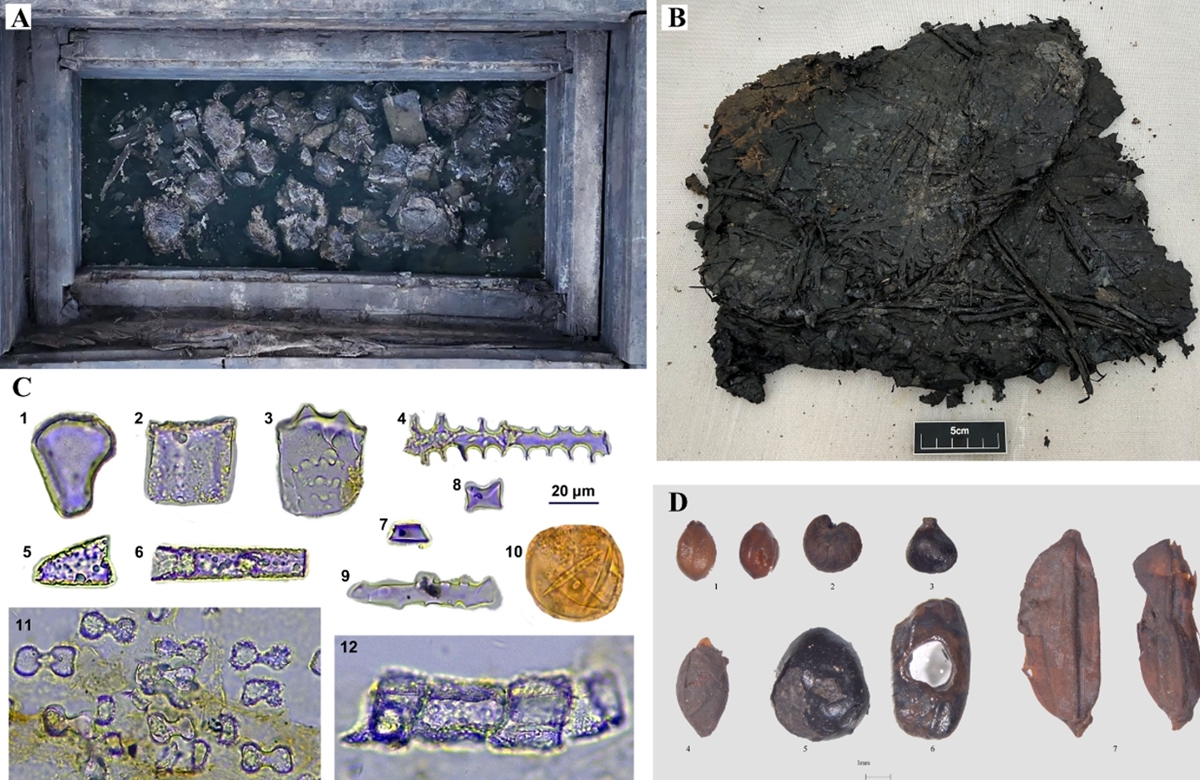
In March 2024, archaeologists from the National Center for Archaeology excavated a large number of well-preserved, waterlogged plant bundles from the tomb's outer coffin chamber. On-site, the plant bundles could be seen tightly wrapped in broad leaves and tied with plant-fiber cords.
A team of researchers led by the National Center for Archaeology, IVPP, and the Chinese Academy of Social Sciences examined 12 of the bundles and found that the wrapping leaves came from oak trees, while the cords were made from grasses.
The bundles mainly contained rice, broomcorn millet, foxtail millet, and cereal seeds, most of which were still in their husks and mixed with inflorescence material. Small amounts of peppercorn, mallow and rice-field weed seeds were also found.
The fact that the bundles were found in a tomb and mainly contained grains still in their husks suggests they were not everyday food, but offerings intended for funerary rituals. "This might reflect a Warring States-era belief that grains served as wealth for the dead in the underworld," Ge Yong, an associate researcher at the IVPP and the study's corresponding author, told the Global Times.
A Qin Dynasty (221BC-206BC) text describes a belief that "soybeans were gold and millet was money" for the dead, indicating that grains held symbolic significance in funerary culture. "The bundles therefore appear to have been ritual offerings prepared for the deceased," Ge said, "not food for the living."
The physical structure of the bundles also resembles that of zongzi, with grains wrapped in leaves and tightly secured with plant-fiber cords. "Similar practices of wrapping grains for burial have also been found elsewhere within the Chu cultural sphere," Ge said, "such as at the Chengyangcheng Site."
At the Chengyangcheng archaeological site in Henan Province, rice and broomcorn millet were also discovered wrapped in oak leaves. "An interesting fact is that we can still find zongzi wrapped with the same oak leaves now in regions related to the Chu cultural sphere."
"The findings suggest that wrapping grains as funerary offerings was a relatively common practice in the Chu state during the Warring States period," Ge said. "And this practice may have been an early form of the zongzi later associated with the legend of Qu Yuan."
These plant bundles share a structure similar to that of modern zongzi and to those described in legends and folklore. This might reflect how, through cultural exchange and heritage, these 2,200-year-old plant bundles likely evolved over centuries, shifting from sacrificial offerings to food, said Ge.
As diverse regional populations adapted the practice, it eventually transformed into the well-known Dragon Boat Festival tradition of eating zongzi. Thus, this structural resemblance might suggest a potential historical lineage; however, experts stressed that the Wuwangdun bundles should not simply be labelled as ancient zongzi.
"We can't define these plant bundles as the earliest zongzi, but rather, we can confirm that by 2,200 years ago at the latest, the Chu region had established a tradition of using this specific form of plant bundles for funeral rites. And this tradition could be a possible origin or precursor of the well-known zongzi," said Ge.
He added that the discovery provides critical physical evidence to explore the origins of zongzi and its cultural heritage.
。
据央视新闻,当地时间5月10日,俄国家杜马(议会下院)审议通过米舒斯京出任俄罗斯新一届政府总理的提名。
据悉,432名投票议员中,有375人支持、0人反对、57人弃权。
此前,当地时间5月10日,俄罗斯国家杜马(议会下院)主席沃洛金表示,总统普京向国家杜马提议由米哈伊尔·弗拉基米罗维奇·米舒斯京出任新一届政府总理。

二 |
按照俄罗斯宪法规定,提名需经国家杜马审议并批准。据今日俄罗斯通讯社报道,普京7日正式就任新一届俄罗斯总统后,俄上一届政府按照相关程序辞职,米舒斯京以代理总理身份在新政府正式成立前履行职责。
米哈伊尔·弗拉基米罗维奇·米舒斯京 (图片来源:新华社)
据新华社,米哈伊尔·弗拉基米罗维奇·米舒斯京,1966年3月3日出生于莫斯科市,1989年毕业于莫斯科机床工具学院,获系统工程师职业资格。
2003年获普列汉诺夫经济科学院经济学副博士学位,2010年获国民经济管理学院经济学博士学位;
1992至1998年就职于非营利性组织国际计算机俱乐部;
2008至2010年转任联合金融集团(UFG)总裁;
Current article:http://www.tibiantasangnenti.buzz/2vsi/20260826/12428.ppt
Published on:12:32:13
- 50403CBA:工资帽规范运动员薪酬、引导俱乐部健康可持续发展
- 96719塔城彩民收获 刮刮乐“囍”100万元一等奖
- 769魏牌全新中大型SUV亮相:造型过于狂野被吐槽 高管回应马上改
- 1902026WRC观察:从造“身体”到采“数据” 机器人赛道换挡
- 426289钢铁独角兽,试装中国芯
- 6463656Lily Collins reacts to Paris–Rome Buzz around Emily in Paris Season 5
- 3658607区领导调研重点企业培育情况
- 905道路罚单将提价,毒驾酒驾无证驾驶将被严打
- 96045市税务局“5·15政务公开日”主题宣传活动精彩纷呈
- 746平多新款iPhone XS/Max/XR降价,最高降价1500元以上
- 41198《地铁 2039》全新预告片亮相 2026 科隆游戏展,2027 年 2 月发售
- 82276Samantha Ruth Prabhu Reacts to Sheetal Nidimoru’s Heartfelt Post on Wedding
- 3036日本高频交易公司Dharmacapital迁至新加坡
- 5104《巫师3:狂猎》DLC旧时曲新图公布!首发中配 最低GTX1660
- 9928英女王伊丽莎白二世灵柩将从爱丁堡启程返回伦敦
- 434贵州多家酒企捐款支援疫情防控_贵阳市_工作
- 4468今年第二个龙年龙月龙日龙时 四龙再次聚首快来接好运
- 2961089把美丽中国建设宏伟蓝图变成美好现实——国新办发布会展望“十五五”美丽中国建设新图景
- 6460610,000-square-meter 'Robot Consumer Street' debuts in Beijing
- 1889谷歌杀入法律 AI 赛道,推出专用 Gemini 工具
- 6623加州法官裁定,执法部门不应强迫嫌疑人使用面部识别码或触摸识别码解锁iPhone。
- 375042023年“世界艾滋病日”系列宣传 | 你知道今年“12·1”是第几个“世界艾滋病日”吗?
我的网站热门国内
- Copyright @ 2016-2017 我的网站 版权所有