


欢乐喜剧人
China's earliest tinned iron armor found in Zhejiang: 1,700-year-old anti-rust tech revealed_我的网站

一 | 9月26日,在中华人民共和国成立75周年来临之际,通武线抚顺县官山至县界段一级公路建成通车。
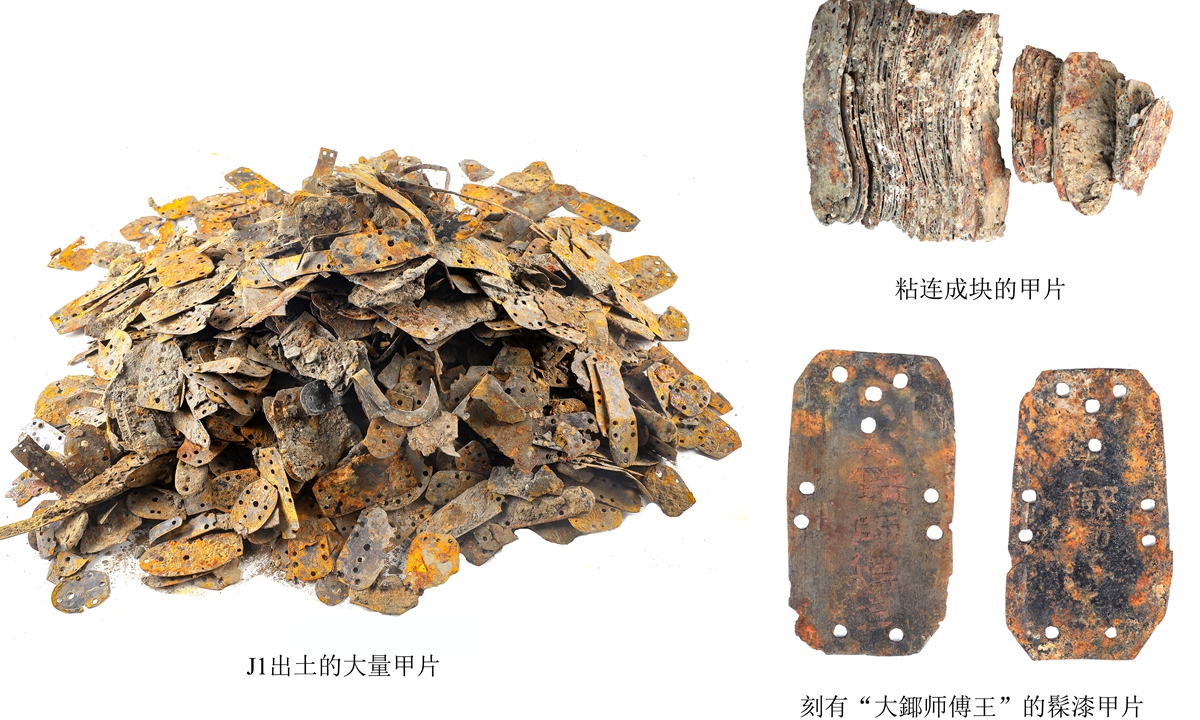
While China has a long history of making tinned bronze and tinware, there has long been a lack of reliable historical records or physical evidence to prove early local production of tinned iron artifacts. The newly discovered armor plates can fill this gap, demonstrating that, by no later than the Wu period, local craftspeople in Zhejiang Province had mastered the art of tin-plating iron surfaces. This reflects the region's advanced metallurgical skills at that time, Ge Shuaikun, a researcher at the Shaoxing Institute of Cultural Relics and Archaeology, told the Global Times on Tuesday.
Over the last three years, archaeologists working at the Jizhong ruins site have excavated hundreds of tinned iron armor plates from ancient wells and ash pits. A preliminary investigation confirmed that the surfaces of these plates contain high levels of tin. Subsequent laboratory analyses were conducted in collaboration with the Shaoxing's institute and the Institute for Cultural Heritage and History of Science & Technology at the University of Science and Technology Beijing with methods such as Scanning Electron Microscopy with Energy Dispersive Spectroscopy (SEM-EDS), X-ray Diffraction (XRD), and Micro-CT to deeply examine the samples' materials, structures, and technological traces.
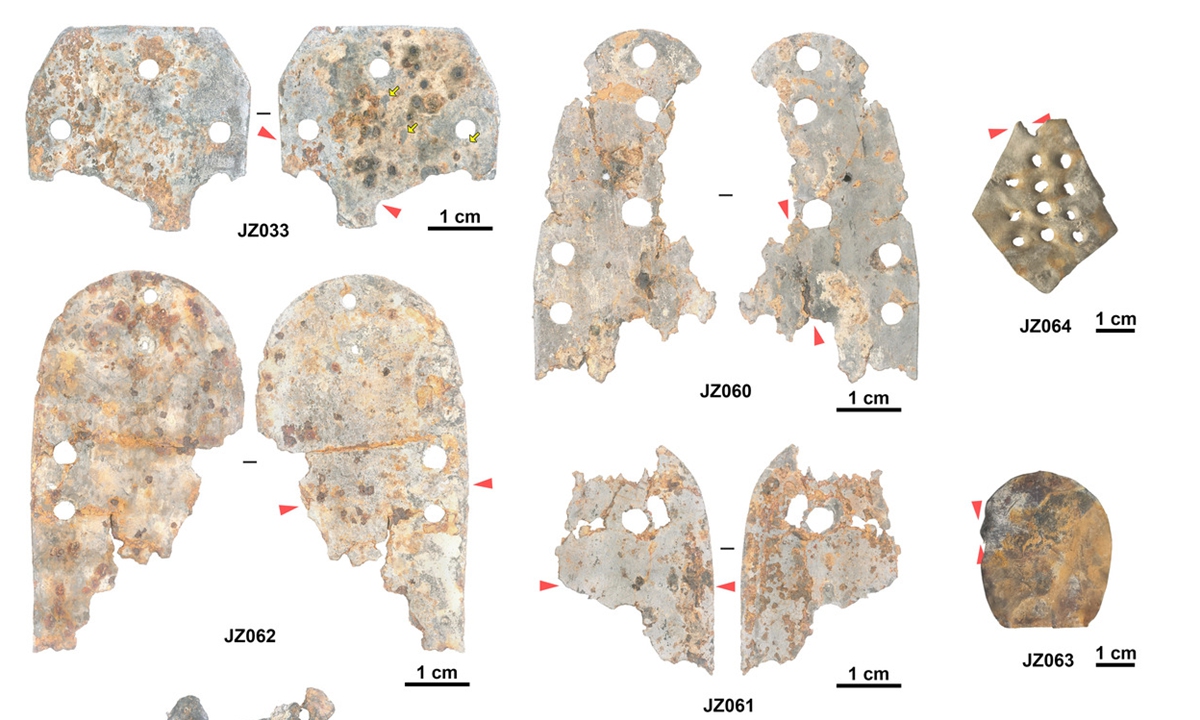
Research shows that the craftspeople immersed iron armor plates in molten tin, thus ensuring complete coverage of the surface with a continuous tinned layer. This coating isolated the iron from exposure to air and moisture, dramatically boosting corrosion resistance. Many of the excavated tinned armor pieces still show a clear, bright silver-white finish.
One major reason for tin-plating the armor was to prevent rust. At the same time, the silvery white shine of tinned iron offered a more striking, beautiful appearance, standing out from the typical dark iron armor of the era. This visual distinction may have marked these pieces as a higher-grade military asset, according to an article from the University of Science and Technology Beijing's official website.
The article said that in earlier eras, from the pre-Qin to Han dynasties, tin was widely used as a surface coating on bronzeware and ceramics. Researchers believe the tin-plating of iron armor discovered at the Jizhong ruins site during the Wu period of Three Kingdoms built upon this local tin-coating tradition, representing an adaptation of those techniques across different materials. The process likely benefited from technological exchange among various specialized workshops at the site, including those making bronze castings, iron weapons, and other metallurgical products.
。 通武线是抚顺市“十四五”规划公路网格局中“九横”道路之一,是抚顺南部东西向的交通大动脉,也是通往沈阳等南部城市的最快捷通道。此次改建完成的抚顺县官山至县界路段,原为双向两车道二级公路,路面宽度仅为12米。 随着经济发展提速,客货运输车辆增多,该道路出现了严重的车辙、沉陷等问题,经常造成拥堵,通行压力较大,成为制约抚顺县再生资源产业园、木制品加工产业园和旅游景区对外客货运输的“卡脖子”难题,急需改造。

二 | 抚顺县将该路段改建工程纳入重点建设项目,总投资1.35亿元。2022年8月开工建设,改建路线全长7公里,采用双向四车道一级公路标准,路面宽度19.5米,全线包含4座桥梁,达到了“畅、安、舒、美”的改建标准。

三 | 通武线抚顺县官山至县界路段的建成通车,将在一定程度上优化抚顺市路网布局,拓宽抚顺市、抚顺县与沈阳市之间的联系纽带,对市、县经济社会发展起到良好的推动作用。随着交通运输条件的进一步改善,抚顺县的梨花谷景区、三块石国家森林公园、救兵木制品加工产业园区和石文再生产业园的客货运输条件将得到全面改善,沿线百姓出行和特色农产品外运也将更加便捷,成为赋能抚顺县乡村全面振兴的又一有力举措。 责任编辑:刘春阳。
Current article:http://www.tibiantasangnenti.buzz/xla/lamp6.htm
Published on:07:38:43
 招金矿业:上半年归母净利润15.78亿元,同比增长9.61%
 China's South-to-North Water Diversion middle route delivers over 80 billion cubic meters, benefiting nearly 118 million
 郴州市副市长唐力勇“拟进一步使用”,曾任长沙银行行长
 曼联儿子上演C罗式超车破门,曼联球迷:比一线队球员更强
 福州优化不动产登记服务网点布局
 兴城市入围“东北县域经济发展潜力十强”榜单
 乐高还原《I Spy》系列丛书经典场景
 全球最快游戏CPU!AMD锐龙7 9850X3D降至历史最低价:比9800X3D还便宜
 两岸青少年闽清同行 开启研学之旅
 张丹丹不需要道歉
 第一款被曝光的骁龙8 Gen2旗舰 一加11 Pro来了:辨识度拉满_Cortex_核心
 3亿变960万!全明星中锋!最快速度交易人家